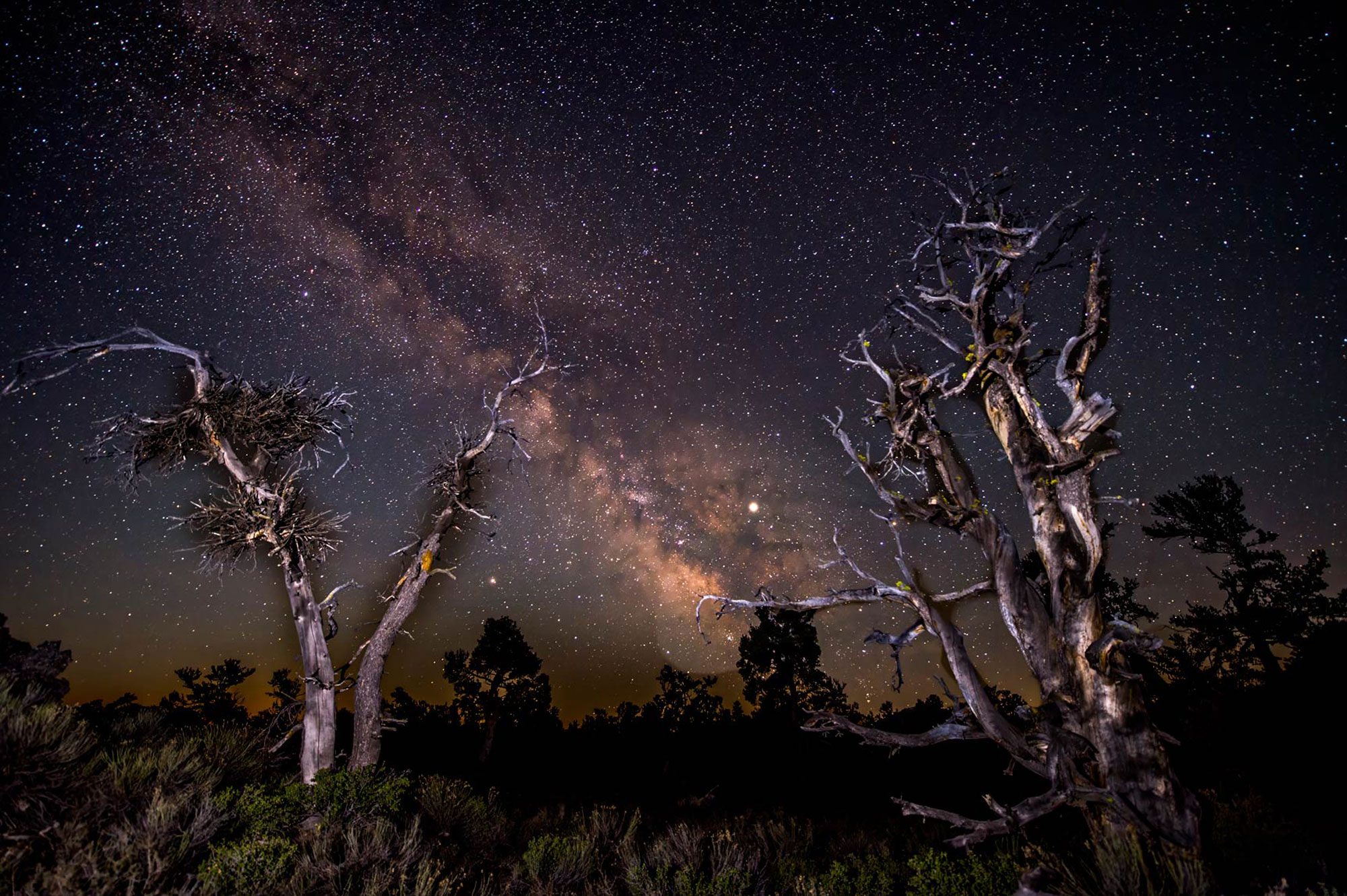
Most of the photography I do involves subjects that are, in some sense, aware of me. A room of people I can walk into. A plate I can turn toward the window. Even the desert, patient as it is, is at least reacting to the same sun I'm standing under. The Milky Way doesn't care that I'm there. It's the most indifferent subject I've ever pointed a camera at, and paradoxically, that's exactly what I love about shooting it.
There are very few moments in our ever expanding and interconnected world where I can feel so insignificant and small. Scuba diving comes to mind, so does hiking through a national park. But those moments still do not compare to standing in the dark, in the middle of nowhere, pointing my camera up into the night sky and feeling a quiet stillness where my footprints are blown away with the next gentle breeze.
Astrophotography strips away almost everything else photography usually relies on: expression, direction, timing in the human sense. What's left is just planning, patience, and a genuine fight against how little light you actually have to work with.
Getting there is most of the work
Long before any camera comes out, the real project is finding a place dark enough to see anything at all. Light pollution is the single biggest obstacle in this kind of photography, and it's not something you can fix in the field. A city sky, even a suburban one, will wash out the Milky Way's faint band entirely, no matter how good your gear is or how patiently you wait.
So the planning starts with a map. Genuinely, a dark-sky map, checking how far you need to travel from the nearest city glow. Then it's checking the moon phase, because a bright moon does almost the same damage as a nearby town; you want a new moon or close to it, ideally on a night when the forecast is clear and stable. By the time I've accounted for darkness, moon phase, weather, and the time of year the galactic core is actually visible above the horizon, the list of nights that will actually work has usually narrowed down to a small handful. Astrophotography rewards the person willing to drive two hours on a Tuesday because the conditions happen to align, not the person who waits for a convenient weekend.
The exposure has to do the seeing for you
Your eyes, even fully adjusted to the dark, can't see the Milky Way in anywhere near the detail a camera can capture. That gap between what you can see and what the sensor can gather is the whole trick of this kind of photography.
A wide, fast lens matters enormously here. Something that lets in as much light as possible, because you're gathering photons from thousands of light-years away and there simply aren't very many of them arriving at any given moment. A sturdy tripod is non-negotiable; there's no handholding a fifteen- or twenty-second exposure. And that exposure length itself is a genuine balancing act: long enough to pull real detail out of a nearly black sky, short enough that the stars haven't started to visibly streak from the earth's own rotation. Push past that limit and pinpoint stars turn into short trails, which might be the effect you want, or might just be a ruined frame, depending entirely on your intention going in.
Focus is its own quiet challenge too. Autofocus mostly gives up in near-total darkness, so I focus manually, usually on the brightest star or planet I can find in the frame, checking and rechecking at full zoom on the camera's screen before I commit to a real exposure.
Waiting for your eyes, and the sky, to adjust
There's a strange, quiet stretch at the start of every astro shoot where nothing much happens. Your eyes need real time to adjust to the darkness. Sometimes twenty minutes, sometimes closer to thirty, before you're actually seeing the sky as well as you're going to. Rushing this part just means shooting blind, guessing at composition in a darkness you haven't actually adapted to yet.
I've come to genuinely enjoy that waiting period. Standing under a sky dark enough to actually show you the galaxy you live in is rare enough on its own, camera or no camera. By the time the first real exposure comes back on the screen, the band of the Milky Way rendered in a way your naked eye never quite achieved, it feels less like you captured something and more like the camera simply proved something was there all along.
So if you're chasing the Milky Way for the first time, budget more patience than gear. Find real darkness, pick your night carefully, let your eyes adjust before you touch the shutter, and trust the exposure to reveal what you can't quite see yourself. The sky was never hiding it. You just needed the right conditions to finally notice.